

The World Economic Forum and its flagship annual shindig in Davos have long served as a barometer for global elite sentiment, drawing world leaders, CEOs, and influencers to discuss pressing economic and social issues. Its reputation in the British media has proved far from unchanging.
From globalisation to elitism
Coverage of Davos and the WEF as a whole has evolved over the past thirty years, reflecting broader societal changes – from optimism about globalisation to increasing scepticism amid rising inequality, populist backlash and institutional scandals.
At its Blairite peak, Davos was viewed as a constructive platform for international cooperation and potential to foster global solutions to huge international problems.
Early success stories: Davos as a platform for global cooperation
A BBC explainer from 2018, “Davos: A rough guide to the World Economic Forum,” noted its historic successes:
“Perhaps the best-known example of this is of Turkey not going to war with Greece when tensions escalated between the two in the 1980s. The oft-cited reason is that former Turkish Prime Minister Turgut Ozal had met his Greek counterpart Andreas Papandreou in Davos and felt he could trust him.
More recently, the BRICS New Development Bank – an alternative to the World Bank and the IMF – was conceived during a conversation between economists Lord Stern and Joseph Stiglitz in Davos in 2011.”
When did Davos peak? Media sentiment and reputation analysis
Analysis carried out by bClear Communications suggests the reputation of Davos, at least in terms of the way the media reports on it, reached a high point in 2005 before falling to a nadir twenty years later, to the point that the media have been talking about its demise.
“It has been suggested that the World Economic Forum’s annual meeting in Davos, the embodiment of the global establishment, is dead. But reports of its demise are greatly exaggerated. Davos is entering a moment of transition that will determine whether it can adapt and retain its relevance.” Michael B G Froman, New York Times
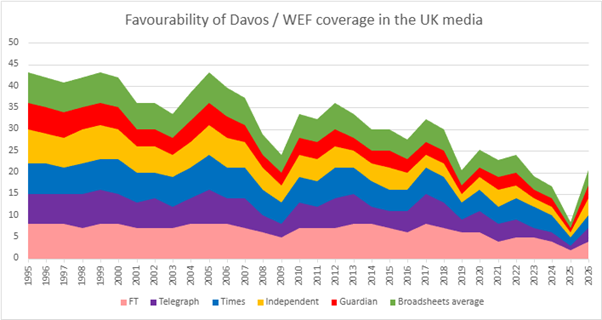
CHART: The declining popularity of Davos in the UK’s quality press
So far, 2026 looks better – especially since Mark Carney delivered an unflinching, elegiac speech met with a standing ovation by those in the room and Emmanuel Macron’s thinly-veiled attack on Donald Trump.
But 2026 could hardly fail to look worse than 2025.
In the UK, the internationalist Financial Times is the biggest supporter of Davos. Coverage from the 1990s and early 2000s was generally positive, focusing on the forum’s growing role in promoting globalisation, economic integration, and collaboration among leaders in a post-Cold War era. Even in the mid-2010s, the FT was still highlighting the participation of leaders like Xi Jinping and Trump, as well as themes of recovery.
“Lifting people out of poverty”
The Times has been more positive than the Telegraph – although even in the Telegraph, coverage in the 1990s and early 2000s was generally positive, highlighting historical breakthroughs like reconciliations and high-profile moments such as Mandela or Clinton appearances – with the occasional note on protests but an emphasis on the forum’s role in global cooperation.
As late as 2016, the Telegraph featured an optimistic take from WEF founder Klaus Schwab himself, highlighting the forum’s self-perceived evolution and relevance.
Under the headline “Davos must confront a world at a tipping point,” Schwab reflected on its historical progress: “I will always be an optimist, because if you look at the progress made during the 46 years since our first meeting in 1971 – when we were four billion souls, now expanded to 6.5 billion – in lifting people out of poverty, in integrating them into a more decent and dignified life, or the progress that has been made in health, life expectations and education, not to mention the triumph of democracy over dictatorship, it is impossible to be anything else.”
Globalisation was not a dirty word at the time and Schwab (whose reputation was still relatively untarnished) was prepared to praise Davos’ role in it: “Then we had the spirit of globalisation – the world was growing together, Europe was growing together and this seemed very promising.”
The financial crisis and the start of Davos’ media decline
It couldn’t last. Coverage became less positive in the late 2000s amid the financial crisis when Davos was portrayed as sombre and out of touch – even in the Financial Times. Positivity declined more sharply from the late 2010s with a renewed focus on elitism and the absence of important leaders.
The lowest scores came in recent years, with 2025 dominated by scandals around Schwab, including misconduct allegations, governance probes and whistleblower claims on toxic culture.
Davos in 2026: Can the forum still claim relevance?
While the Financial Times has been the biggest backer of Davos, the Guardian has been its harshest critic, with its tone turning much faster than the other broadsheets. Effectively, the long-term reputation of Davos in the Guardian has been on a downward slope since 1997.
The 2026 coverage was emphasising organisational struggles for relevance, geopolitical pressures like Trump-Ukraine talks, and efforts to attract sponsors amid debates over the forum’s future direction. But that was before Mark Carney and Emmanuel Macron took to the stage.
“You can’t have a healthy business in an unhealthy world”
In 2015, on the BBC, the then CEO of Unilever, Paul Polman, defend attendance at Davos saying: “We go to Davos to do this and to represent people who can’t be there – those who live in poverty or are too hungry to go to school, those who may not even have made it beyond the age of five due to malnutrition, natural disasters or simply poor sanitation. Actions there can make a tangible difference.”
He cited specific achievements: “Last year, actions at Davos led to over 170 key players committing to ending deforestation by 2030. Great strides were also made on food security and the Grow Africa initiative helped mobilise investment pledges of more than $10 billion by over 160 companies.
“The Scaling Up Nutrition plan to stop stunting was also accelerated there.” Polman emphasised the forum’s unique convening power: “There is simply too much at stake… We have the unique opportunity to be the first generation to bring an end to poverty and the last to prevent the worst impacts of climate change… It’s a business, as well as a moral, argument. You can’t have a healthy business in an unhealthy world… That’s what happens at Davos. It brings together young entrepreneurs, leading NGOs, the UN Secretary General and presidents of over 60 countries. We simply cannot do it alone.”
Positive change or sweatshop shame?
Polman pitched Davos as a vital hub for cross-sector collaboration, where business leaders could drive positive change.
Even following the historic interventions of Carney and Macron, would the CEO of Unilever say this today?
I doubt it.
Over the course of the last decade, Davos has come to be seen as more performative than productive. Now Davos is more likely to be portrayed as a symbol of out-of-touch elitism, corporate hypocrisy – even conspiratorial intrigue. A 2016 Guardian column by Steve Hilton, former advisor to David Cameron, and host of The Next Revolution on Fox News, lambasted Davos under the headline “Let’s make attending Davos as shameful as running a sweatshop.”
Despite this year’s comeback, we aren’t a million miles off that point.
Written by: James Staunton a director of bClear Communications
Read our next blog on: Why b2b start-ups & scaleups need a PR strategy