

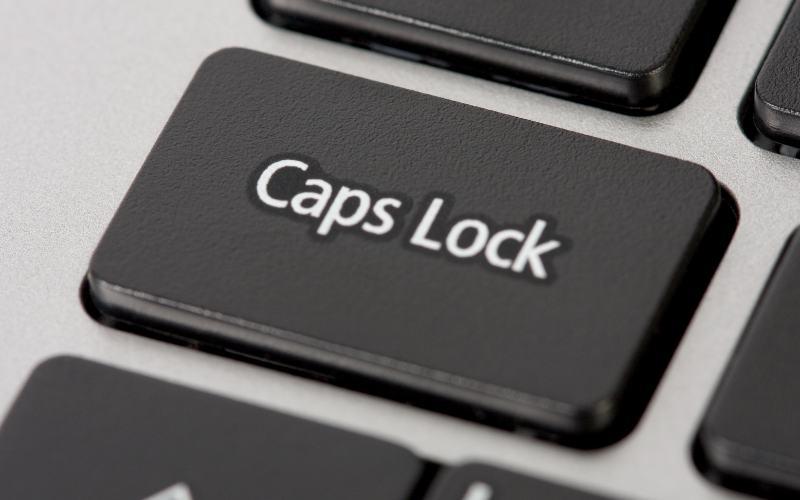
my cap lock key isn’t broken. i’m just trying something out…
It’s not just bad grammar; it’s a stylistic choice. Gen Z is dropping capital letters in favour of quick and easy lowercase exchanges. This is happening not only in text messages and on social media but in everyday communication. According to Jason Dorsey, a generational researcher and president of the Center for Generational Kinetics in Texas, “this isn’t just about laziness – it’s a generational shift in how communication is evolving in a digital age”.
punctuation and tone
The consensus seems to be that writing in lowercase is more relaxed and approachable. It’s honest, effortless and authentic. It shows you aren’t trying too hard or overthinking what you’re about to type. In contrast, using capital letters is anecdotally considered formal and inauthentic. Hitting the Caps key shows pre-planning and an element of ‘think before you speak’. It’s punchy and to the point.
It could be argued that playing with case adds clarity. Avoids a message being misconstrued without intonation. As a Millennial I have a similar aversion to the full stop. When communication is brief, adding a full stop seems terse. Why risk upset or misunderstanding when you can use a smiley-faced emoji instead and ensure everyone is on the same happy page?
brands setting the trend
Gen Z aren’t wrong about minuscule being more approachable either, as many brands with lowercase wordmarks will attest. Amazon, eBay, Mastercard, BP, Airbnb and Adidas are just a fraction of the mainstream brands that have eschewed the capital letter completely in their logos. Even at bClear we’ve dropped the initial capital. Not only does this frame the brand as more friendly and approachable, but it also has benefits in terms of aesthetics: aiding readability and improving the symmetry of the design.
Plus, for many brands this isn’t a recent change. Facebook has had an exclusively lowercase logo since its inception in the early noughties, and Twitter was the same before it converted to X. Is it any wonder then that young people are following the precedent set by the brands and platforms they are using?
However, the fact that lowercase writing has reached beyond the realms of social media and text messaging – into schools and the workplace – has people worried. The growing use of AI isn’t helping. AI platforms don’t require you to use proper grammar when asking questions, and many correct your grammar and spelling in real time as you type. Young people can go through their days never pressing Caps once if they so choose.
is the capital letter dead?
But does this mean death to the capital letter? I don’t think so. Although I may rarely add one to a text message, I haven’t forgotten how to use a full stop. When telegrams were a prominent form of communication and space was at a premium, humanity didn’t forget how to write in full sentences. Text speak didn’t herald the end of vowel usage. Plus, while AI platforms may humour the trend, they are ultimately correcting the mistakes and keeping Gen Z on the grammatical straight and narrow.
On the other hand, if this did spell the beginning of the end for the capital letter, would it matter? The use of capitalisation was only standardised in the English language at around the turn of the 19th Century. Prior to that, and since the invention of the printing press, English had reflected German typography with most nouns capitalised – proving change can and will happen. There are also many writing systems around the world that don’t use capital letters at all, like Georgian, Hebrew and Arabic. Not to mention languages that use syllabaries.
But for now, capital letters do still have their place in the English language, and even Gen Z has a need for them. I have several younger friends who type exclusively in capital letters to convey shouting, laughing or emphasis when required. Almost all those companies with lowercase wordmarks still type their names with a capital letter featured, even if it’s not the first letter.
communication, clarity and authority
A capital letter has a role to play. Along with the full stop, it indicates a sentence break and a place to breathe. In longer form copy, it aids readability and adds clarity. Capitals also help to differentiate names from other nouns – clarify if you need faith, or Faith from HR. Plus, while it may be irritating, Gen Z calling capital letters ‘too formal’ at least illustrates an awareness that they should be used in a formal setting. That there is a time and a place for grammatically correct, thought-through communication. As such, in a comms space, we shouldn’t be too eager to jump on the bandwagon. For companies specifically looking to target a younger audience, a lowercase wordmark can be attractive to that demographic, but further use of lowercase in communication should be carefully considered. You don’t want your brand to be viewed as the uncool dad trying too hard to fit in with the kids.
It also matters what you’re trying to sell. Following a trend like this can work well for a lifestyle brand; but when young people are looking for more serious advice on topics like money, health or politics, formality is a clear indicator of authority and experience. While many Gen Z are choosing to forgo the capital letter in their own communication, it’s expected from the older and wiser. Mimicking a younger writing style could be considered unsophisticated and trivialise core messages, doing serious damage to a brand’s reputation, even in the eyes of those who haven’t used Caps in over a week. Plus, in a space where every move is analysed, using a communication style that expresses pre-planning and to the point messaging – as opposed to off the cuff fluff– is no bad thing.
“[I]f history has taught us anything, it’s that every generation has its own way of pushing language forward,” adds Dorsey. Whether Gen Z can bring about the biggest shift in grammar for several hundred years, only time will tell.
Written by: Alice Straker