

When people think of PR, they picture frantic teams trying to rescue a brand after a CEO says something regrettable. A swamp of ringing phones, keyboards clattering, coffee dripping down the side of a desk, a titan-like boss growling orders from the centre of the room. It’s a visceral image, and an entertaining one at that, but public relations – or, more broadly, the art of shaping perceptions – is not some hyper-modern capitalist invention. It’s as old as history itself. Whether you’re winning votes, swaying opinion or promoting ideas, narratives have always mattered.
Caesar: Master of messaging
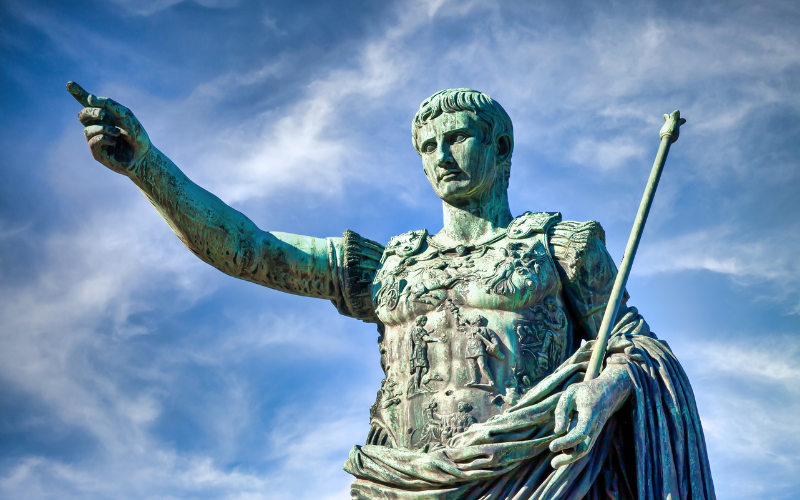
Julius Caesar wasn’t just a general and eventual dictator of the Roman Empire; he was one of history’s first recorded masters of PR. His famous line veni, vidi, vici (I came, I saw, I conquered) wasn’t a military report. It was a press release in miniature. Short, sharp, memorable. The Roman Senate received a headline-worthy statement, and the world remembers it to this day.
Elizabeth I: The power of image
Fast forward to the 16th Century and Elizabeth I was developing PR into a multi-sensory medium. The Virgin Queen carefully curated her public image through portraits; she wasn’t the first to do so and when you look at social media, she certainly isn’t the last. In her portraiture, she was strong, stern, regal, and untouched by age or illness, even when reality was less flattering. This was PR before social media filters. Her image shaped perceptions of power and authority, proof that presentation often matters as much as substance.
Milton: The devil’s PR agent
In the 17th century, poetic great John Milton showed just how powerful language can be in shaping perception. His magnum opus, the poem Paradise Lost, set out to “justify the ways of God to men,” but many readers found Satan’s fiery speeches the most fascinating and persuasive part of the text. Milton didn’t intend it (we hope), but he ended up giving the devil some of the best PR in literary history. Proof that narrative and framing can shift sympathy in unexpected directions.
Napoleon: Control is king
Napoleon Bonaparte once said, “four hostile newspapers are more to be feared than a thousand bayonets”. Believe it or not, he even travelled with his own printing press to shape battlefield reports. Controlling the narrative can be as decisive as any military strategy or weapon and he knew it.
Gandhi: Storytelling and strategy
Gandhi’s Salt March in 1930 wasn’t just a protest, it was strategic communication genius. By focusing on something as everyday as salt, he made a complex issue of colonialist oppression simple, relatable, and shareable. Simplicity, strategy, and narrative can be more persuasive than sheer force.
Churchill: Rhetoric as leadership
Wartime Britain didn’t need data sheets, it needed belief. Winston Churchill knew his words had to inspire as much as inform. At the age of just 22 he noted that “no talent is so precious as the gift or oratory.” He was right. His speeches balanced brutal honesty with hope, accountability with optimism, and turned fear into resolve. The lesson: timing, tone, and clarity can rally entire nations.
Bernays: The birth of modern PR
Edward Bernays, Sigmund Freud’s nephew, pioneered modern public relations. He sold bacon and eggs as “the all-American breakfast” and cigarettes as “torches of freedom.” Controversial as it was and may now seem, his work showed the power of framing and influencing public perception, lessons that echo through history.
The modern masters
In the 21st century, figures like Elon Musk have redefined PR for the digital era. With a single tweet (if that is what it is still called), Mr Musk can move markets, dominate headlines, and shape public perceptions worldwide. He demonstrates that strategy, timing, and a keen understanding of the media remain as powerful as ever.
From Caesar’s slogans to Musk’s tweets, history is littered with PR masters who understood that perception outweighs power. As Churchill quipped, “history is written by the victors.” Perhaps more accurately, it’s written by the best storytellers, by the masters of PR.
Written by: Thomas Hale
Read more about our charity support: Is it the beginning of the end for capital letters?